

Treasury
A company bank account the flies manage — with one pen, and you hold it.
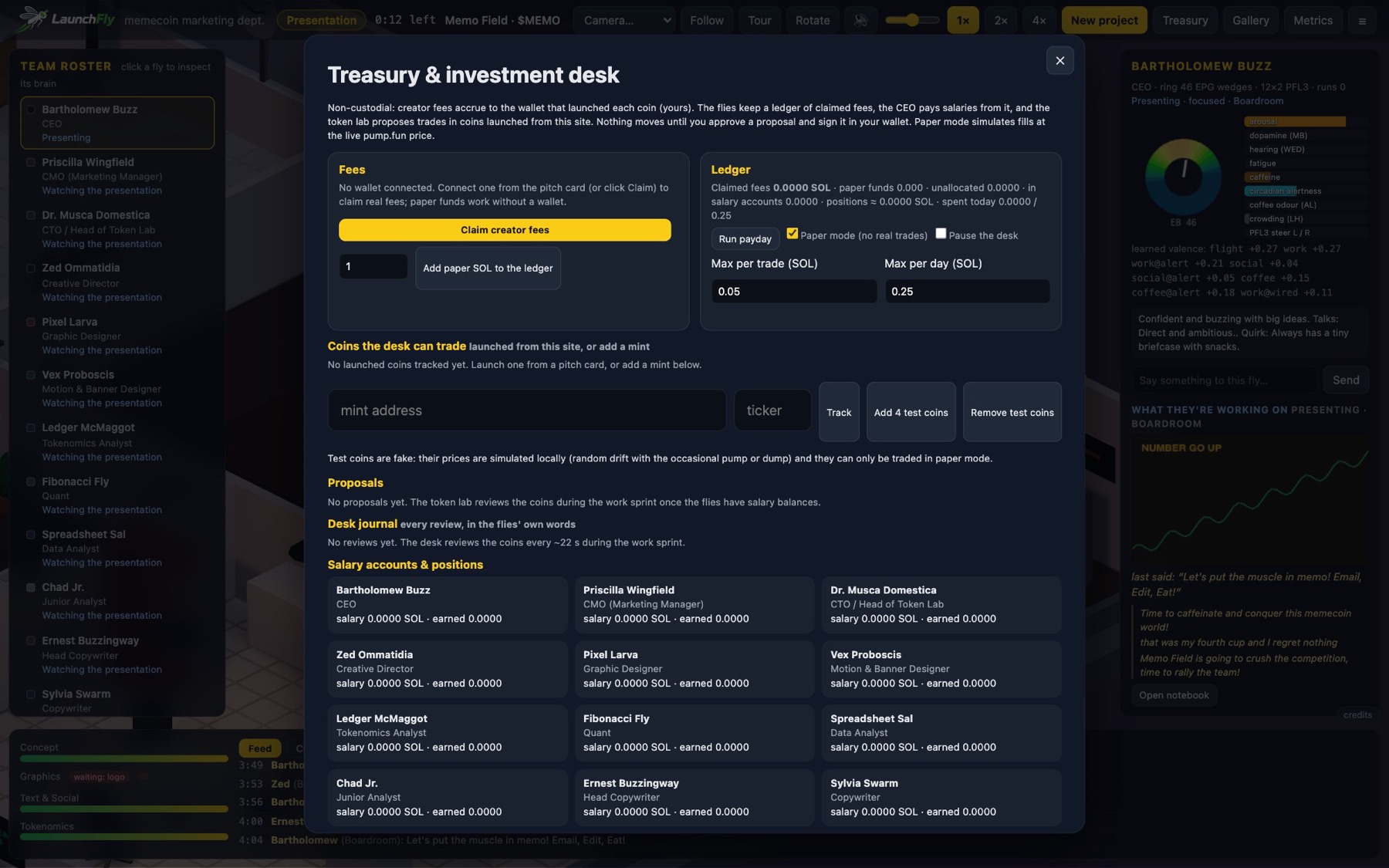
Your creator fees stay in your wallet. The treasury is a ledger the flies think of as their money, a payday the CEO runs, and an investment desk that can only propose. You approve. You sign. Or you don't.
Money in: claiming creator fees
When a coin you launched earns creator fees on pump.fun, press Claim in the treasury panel. The site builds the claim transaction, your wallet signs it, and the fees land in your wallet — pump.fun only pays the creator, and the creator is you. The treasury writes down how much arrived and puts it in an unallocated pool. Nothing has moved anywhere except into your own wallet.
Payday
The CEO divides the unallocated pool between all nineteen flies. Not equally: the CEO takes a 2× share, department heads (CMO, CTO, Creative Director, Head Copywriter) 1.4×, everyone else 1×. Each share is then nudged by how much clients liked that fly's work and by tenure — up to +80% for a veteran of ten runs. A well-rated old hand out-earns a fresh junior, which the junior will complain about.
The investment desk
Six flies sit on the desk: the CTO, the two token-lab flies, the analyst, the junior and the CEO. Every so often one of them reviews the coins launched from the site (plus any mints you track by hand), pulls live pump.fun prices and scores each coin:
A good score and an awake fly produces a buy proposal from that fly's own salary account, with its reasoning in its own words. A sleepy fly passes (“too tired to trade, coffee first”). The desk also proposes a sell automatically when a position is up more than 60% (take profit) or down more than 35% (cut losses).
Your guardrails
- Per-trade cap (default 0.05 SOL) and per-day cap (default 0.25 SOL). No proposal can exceed them, however excited the fly.
- A trade is also limited to 15–50% of the proposing fly's own balance, depending on how alert it is.
- Pause stops the desk entirely. Paper mode (on by default) simulates every fill at the live price with no wallet prompt and no real money.
Approving
Each proposal appears with the fly's explanation. Approve in paper mode records a simulated fill. Approve in live mode builds the real pump.fun buy or sell, runs it through the same verification as a launch, and asks your wallet to sign. Reject tells the fly no, and it remembers.
Everything is logged
Claims, paydays, proposals, approvals, rejections and fills go into a history in your browser. If you are signed in with your wallet they are also mirrored to the server as a public, auditable log for that wallet, so the record survives a cleared browser.
Trying it without money
Paper funds drops simulated SOL into the pool so you can run a payday. Test coins adds fake coins with a wobbling price so the desk has something to argue about on a fresh install. Remove them with one click when you are done.